Daniel Simon Jr.
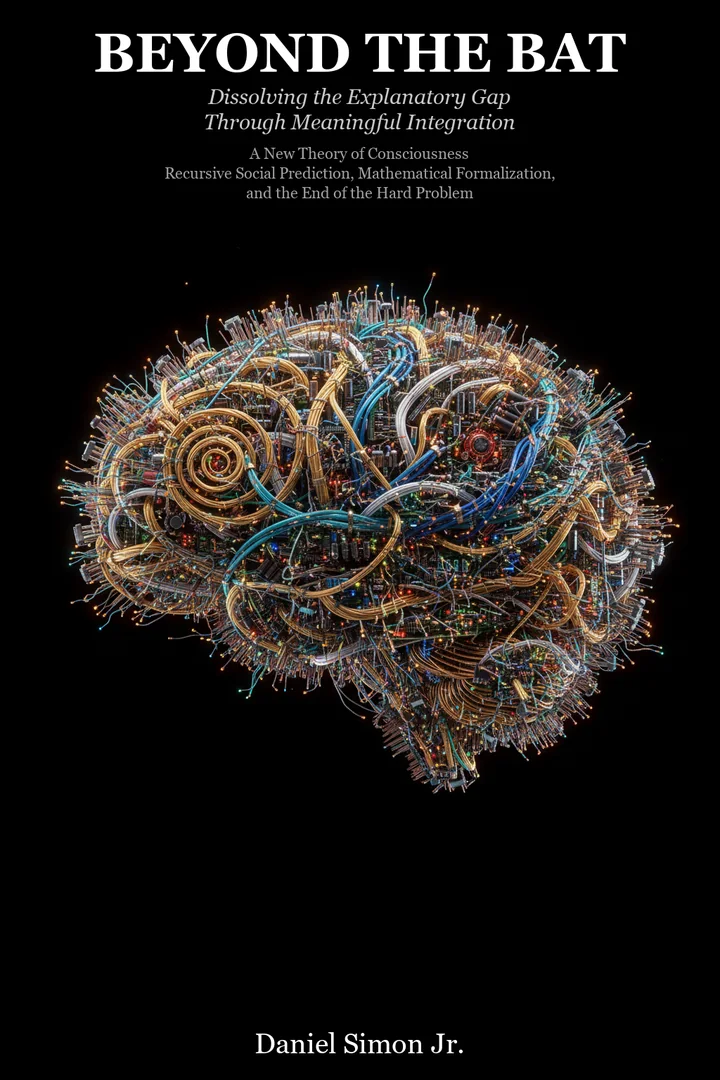
Cover of Beyond the Bat: a brain built of gold and copper wire and teal cable on a black ground, with the title above and the author's name below.

Beyond the Bat

Dissolving the Explanatory Gap Through Meaningful Integration

Why does it feel like something to be you?

For fifty years, Thomas Nagel’s question about what it’s like to be a bat has defined the central mystery of consciousness. Philosophers call it the “hard problem” — the seemingly unbridgeable gap between physical brain processes and subjective experience. This book argues the problem rests on a mistake, and that once the mistake is corrected, the gap closes.

Read the book (PDF, 196 pages) Read it in the browser

About the book

The hard problem of consciousness — why physical processes give rise to subjective experience — has resisted solution for decades. This book argues it was never a real problem. It was a consequence of assuming that experience consists of “raw qualia,” and that assumption is wrong.

Beyond the Bat proposes the Recursive Social Prediction model: consciousness arises when the brain’s social prediction machinery is redirected at the self, creating a recursive loop that constitutes phenomenal experience from within.

The bat question is not “What is it like?” It is “What meaningful integrations does a bat’s architecture perform, and how do they differ from ours?”

What’s inside

  • A strong dissolution of the hard problem: not a reduction, not a dodge
  • A three-level architecture grounded in evolutionary and developmental evidence
  • Eight mathematical appendixes with cross-formalism proofs
  • Seven falsifiable empirical predictions
  • Nineteen theory comparisons across ten families
  • Clinical dissociations (Cotard’s, depersonalization, Capgras, DID) mapped onto architectural failures
  • A formal theory of intelligence with a constitutive identity proposition

Inside the book

Beyond the Bat

Contents

  1. Abstract7
  2. IIntroduction7 The Seductive Error of Raw Qualia
  3. IIThe Traditional Framework and Its Hidden Assumptions9
  4. IIIThe Alternative10 Meaningful Integration
  5. IVThe Feeling of Consciousness18 Social Prediction Redirected at Self
  6. VEvolutionary, Developmental, and Clinical Evidence27
  7. VIObjections and Replies39 Addressing the Social-Predictive Account
  8. VIIWhat It’s Like to Be a Bat43 The Question Reframed
  9. VIIIPhilosophical Implications and Objections46
  10. IXEmpirical Implications and Predictions60
  11. XComparison with Alternative Views66
  12. XIConclusion89 Beyond the Bat
  13. Author’s Note and References93
  14. Mathematical Appendixes106

Predictive coding, free energy, reinforcement learning, control theory, a unified framework, an equation reference sheet, a clinical prediction matrix, and a formal theory of intelligence.

I. Introduction: The Seductive Error of Raw Qualia

The Grip of an Intuition

When Thomas Nagel (1974) asked “What is it like to be a bat?”, he articulated an intuition that feels undeniable: there exists something it is like to have an experience, a subjective, qualitative character that seems irreducible to physical processes. This “something it is like” appears to be prior to any conceptualization, any linguistic description, any cognitive processing. It seems to be raw.

The intuition has proven remarkably powerful. It grounds the “hard problem” of consciousness (Chalmers, 1995), motivates arguments for property dualism, and makes consciousness appear uniquely resistant to scientific explanation. Accept that phenomenal experience has this raw, pre-conceptual character, and we face what appears to be an unbridgeable explanatory gap between physical processes and subjective experience.

But what if the intuition, however persuasive, is simply wrong? What if the very notion of “raw qualia” commits a category error, positing an entity (pure, meaning-independent experience) that cannot exist because experience is necessarily constituted by meaning?

Keep reading in the PDF

Companion papers

Three papers drawn from the book, each written to stand alone.

  1. Part I

    The Dissolution

    The hard problem rests on an assumption that has gone largely unexamined: that phenomenal experience consists of raw qualia, pre-conceptual states existing independently of meaning.

    PDF, 43 pages
  2. Part II

    Evidence and Predictions

    What the evolutionary, developmental, clinical and comparative evidence says about a three-level architecture, and the falsifiable predictions it generates.

    PDF, 62 pages
  3. Part III

    Mathematical Foundations

    The architecture formalised across hierarchical predictive coding, variational free energy, intrinsically motivated reinforcement learning and cascade control.

    PDF, 56 pages

The interactive companion

Twenty tabs of architecture diagrams, theory comparisons, clinical evidence and a live simulation of the loop.

Open the playground. Also available: the poster, a video, and the LaTeX source of Algorithm 1.

Notes and replies

Short essays that read one paper or article against the book’s argument.

All 23 notes

About the author

Daniel Simon Jr. is an independent researcher working at the intersection of philosophy of mind, computational neuroscience, and consciousness science. Beyond the Bat is the author’s first book. Write to Daniel@danielsimonjr.com.

Preprint edition, 2026. Cover image generated with Google Gemini.