Read the work

The argument is published two ways: as three self-contained papers aimed at different journals, and as the single monograph they were extracted from.

Each part stands alone and carries its own abstract, references and conclusion. Read in order they build one argument: why the hard problem dissolves, what evidence bears on it, and how the architecture is formalised.

Part I

The Dissolution

The philosophical argument

The hard problem rests on an assumption that has gone largely unexamined: that phenomenal experience consists of raw qualia, pre-conceptual states existing independently of meaning. This part argues the assumption is false, and that recognising it dissolves the explanatory gap rather than narrowing it.

43 pages · 528 KB · PDF

Read Part I
Part II

Evidence and Predictions

The empirical case

What the evolutionary, developmental, clinical and comparative evidence says about a three-level architecture, and the falsifiable predictions it generates. Includes the clinical prediction matrix mapping architectural failures onto known disorders.

62 pages · 865 KB · PDF

Read Part II
Part III

Mathematical Foundations

The formal treatment

The architecture formalised across hierarchical predictive coding, variational free energy, intrinsically motivated reinforcement learning and cascade control, with proofs that the four are projections of one functional.

56 pages · 2.0 MB · PDF

Read Part III

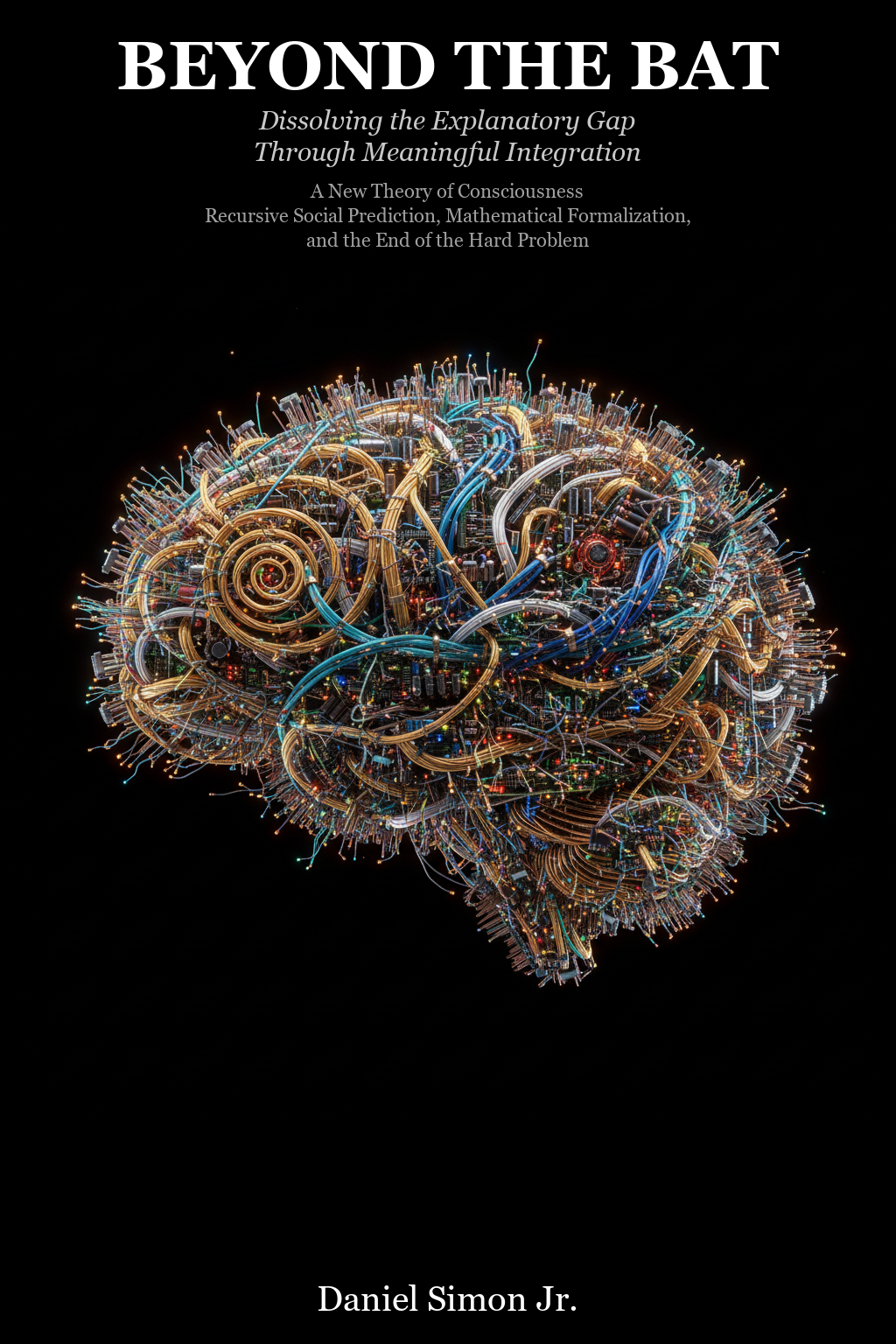
The monograph: Beyond the Bat, complete

Beyond the Bat, front cover

The three papers were extracted from a single book, which remains the fullest statement of the argument: eleven sections and nine mathematical appendixes, including the equation reference sheet, the clinical prediction matrix, the theory of intelligence, and the bilevel-optimisation treatment that the papers only gesture at.

It is not a superset in the tidy sense. The split renumbers objections, moves the comparison material into Part II, and condenses throughout, so a claim can sit in a different place in each. Read the book for completeness and the papers for the argument as submitted.

196 pages · 3.8 MB


Elsewhere on the site: Interactive playground|Replies and essays|Algorithm 1 source|Poster